


HOLY WEEK IN SEVILLE


The processions are organised by religious brotherhoods, or hermandades and cofradías. Each one has its own history, rules, insignia, colours, devotional images and route through the city.


Nazarenos
Members of the brotherhood who accompany the procession wearing the characteristic tunic and capirote, often carrying candles, crosses or insignia.
Pasos
The processional floats carry sacred images or sculptural scenes. They are borne through the streets by costaleros under the direction of a capataz.
Saetas
Flamenco-inspired religious songs performed spontaneously from balconies or at street level as a paso passes.
Silence & music
Some brotherhoods process in profound silence, while others are accompanied by cornet-and-drum bands, agrupaciones musicales or full processional bands.


The pasos are among the most recognisable elements of Holy Week in Seville. Some depict scenes from the Passion of Christ, while others carry images of the Virgin beneath richly embroidered palios. The procession also includes crosses, insignia, candles, acolytes, musicians and long lines of nazarenos.


Music is a fundamental part of many processions. Depending on the brotherhood, you may hear cornet-and-drum bands, agrupaciones musicales or full bands performing processional marches. Other brotherhoods deliberately avoid musical accompaniment, making silence itself part of the experience.


From Palm Sunday to Easter Sunday, the brotherhoods that make station of penitence at the Cathedral pass through the Carrera Oficial, the common official route through the centre of Seville before reaching the Cathedral.

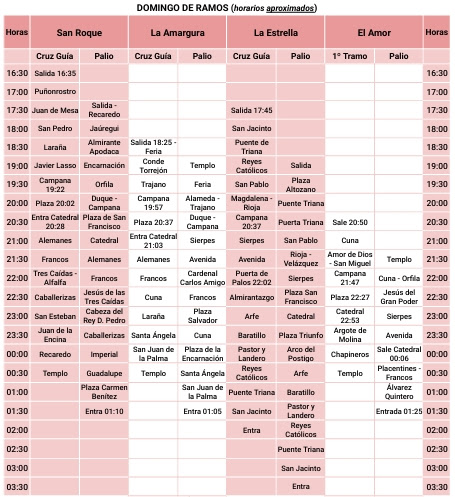
The lists below show the brotherhoods traditionally associated with each day. Their order, routes and exact timings can change from one year to another, so use the official programme for the year of your visit.
Friday of Sorrows

Saturday of Passion

Palm Sunday

Holy Monday


Holy Tuesday


Holy Wednesday


Holy Thursday


La Madrugá


Good Friday


Arrive early
Popular streets and key moments can become extremely crowded. Choose one or two processions and plan where you want to see them rather than trying to follow everything.
Respect the procession
Avoid crossing through the cortege, blocking nazarenos or standing directly in front of people who have been waiting for a long time.
Expect route changes
Rain, delays and operational decisions can alter times or even cancel a procession. Check official information throughout the day.
Wear comfortable shoes
You will probably walk much more than on an ordinary sightseeing day, and many central streets become difficult to cross while processions are passing.
Traditional flavours of Holy Week
Holy Week also has its own seasonal food traditions. Torrijas and pestiños are among the best-known sweets, while bars and homes also serve dishes associated with Lent and days of abstinence.


More Than a Spectacle
Holy Week in Seville brings together religious devotion, sculpture, music, craftsmanship and the urban life of the city in a way that is difficult to separate into individual elements.
For visitors, understanding the brotherhoods, the processions and the rhythm of each day makes the experience much richer than simply waiting for a paso to pass.

No comments:
Post a Comment